
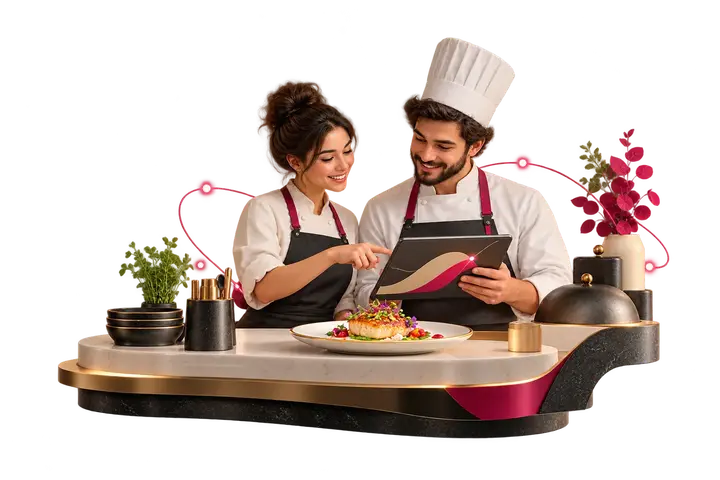
When every product question leads back to the manager, a restaurant loses momentum precisely when service needs it most. A new colleague hesitates over a side dish, an evening employee cannot explain the lunch offer and somebody rewrites the same description again. An AI assistant can make that work easier when it connects to the business's actual products rather than generating a plausible answer from general knowledge. Nina GO AI brings that connection into its menu and content environment. The attractive opportunity is a team that finds its bearings faster and has more attention available for the guest.
Put useful knowledge beside the work
Experience usually lives in people's habits. A senior employee knows which product names are easily confused and which explanation helps a guest choose. Software becomes useful when that understanding is reflected in clear product information that colleagues can consult. Nina GO AI's assistant can work with the known menu context, making a product question part of the workspace rather than a separate internet search.
That changes the quality of a conversation. Rather than asking a colleague to remember everything, a member of staff can identify the relevant product, inspect its available information and ask a more precise follow-up. The assistant supports preparation; the employee still understands the guest's situation.
Make a shift handover concrete
Imagine a neighbourhood bistro introducing a roasted vegetable dish. During lunch, the team notices that guests keep asking whether the sauce is included. The manager clarifies the product description. When the evening colleague begins, the useful starting point is that updated product information, not a hurried explanation that disappears with the departing shift.
In a short joint exercise, the experienced employee and the newcomer examine the dish, its portion and the sauce description. They ask the assistant questions based on that product and compare the answer with what the kitchen actually serves. The benefit is shared language: both employees can explain the same offer. ## Remove repeated drafting from the creative bottleneck
Staff also spend effort on descriptions and content preparation. An assistant can help turn an agreed product idea into a text suggestion, leaving colleagues to improve the wording rather than begin with an empty page. Where translation or media functions are enabled, the same product understanding can support those tasks too. Nina GO AI's preparation approach connects products, design and intended presentation surfaces. The time-consuming part can become a conversation about the right result instead of repeated copying between disconnected notes.
Creative judgement remains valuable. The team knows whether a phrase sounds like the business and whether a picture resembles the food served. Giving them a useful starting point can make that judgement easier to express. It also lets a quieter colleague contribute: choosing between clear alternatives may feel more accessible than being asked to invent a complete campaign while the kitchen is busy.
Teach a working habit, not a magic command
For onboarding, use a familiar dish and a real service question. Let the new employee identify the product, explain it in ordinary words and show where uncertainty remains. A more experienced colleague confirms the answer. This simple practice builds confidence around the restaurant's own offer, rather than training people to trust every fluent response. It can be repeated when a recipe or portion changes and becomes part of everyday product understanding.
Capabilities depend on enabled modules, permissions and provider readiness; paid creation and publication have their own settings. Check the actual package scope for the business. The assistant helps prepare and find information, while the team remains responsible for the service promise it gives.
Build the future around confident people
A future assistant might prepare tailored learning material before a shift or surface relevant product changes during training. That is an opportunity scenario. Today's stronger foundation is already practical: clear products, supported assistance and colleagues who can evaluate the answer together. It rewards the restaurant's existing knowledge instead of treating hospitality as a collection of generic replies.
Bring a real dish and a typical staff question to a Nina GO AI demonstration. Ask how the team would find the relevant information, prepare a useful description and keep the explanation consistent. The best proof is not a dramatic conversation with a machine. It is whether a colleague can move from uncertainty to an understandable answer and return their attention to the person waiting to be served.



