
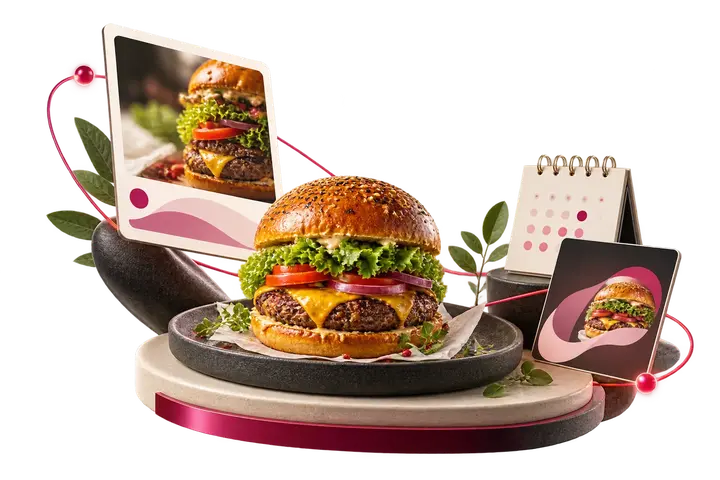
The hardest part of a restaurant campaign is often keeping a simple promise consistent. The picture shows one meal, the caption describes another and the screen repeats a price from an older note. Starting with a known product changes the work. Nina GO AI links menu products, content and screen presentation in a shared environment. An AI-assisted campaign can therefore begin with what the restaurant genuinely offers, then develop an appealing explanation and a suitable moment to show it.
Give the campaign a real product anchor
A campaign needs something identifiable to promote. In Nina GO AI's campaign assistance, the target can be a published product or combination. Its displayed price comes from that menu target; the campaign is not an independent place to invent another price. This gives creative work a useful foundation.
That foundation also improves the brief. What is the meal, what does it include and why would somebody choose it at this service moment? Those questions are more useful than asking for an exciting campaign in the abstract. If a special meal combination is needed, its actual menu definition comes first. A promotional sentence cannot create an offering the kitchen has not agreed to supply, even when the sentence sounds persuasive.
Build the idea around a recognisable meal
Imagine a burger restaurant highlighting a burger-and-drink combination during weekday lunch. The team starts with the published combination and its real scope. It chooses a simple message about a complete lunch choice, not an invented discount or an exaggerated portion.
The same brief can guide an image concept or product text. Staff can judge whether the composition gives the meal enough attention and whether the message explains what is included. An illustrated concept should remain faithful to the food promise; it is not proof that the real plate was photographed. This is where restaurant knowledge improves creative preparation instead of leaving the assistant to guess the ingredients, serving style or commercial conditions.
Use AI to prepare a stronger creative starting point
Nina GO AI's content workflow connects product context and presentation. Where enabled, supported text and media functions can help the team explore ways to explain or depict the chosen offer. A suggested description or visual direction gives staff something concrete to discuss. The aim is not to produce endless alternatives but to find a clear idea that suits the business and makes the product easier to recognise.
A useful review asks what the guest will understand first. Is the combination visible, does the wording match its contents and is the price information consistent with the menu? These are creative questions as well as operational ones. A campaign can be attractive without adding invented urgency or a claim that everybody wants the product. A specific, well-presented meal often provides enough substance for a convincing message.
Match the screen moment to the service
The campaign assistant can prepare day-and-time scheduling for suitable campaign screens. A lunch idea should be visible in its intended window, rather than remain as an unexplained promise throughout an unrelated evening service. The preparation shows the proposed target and timing for approval. Staff can therefore consider the offer and its service moment together before the new arrangement is committed.
For the burger business, this means looking at the lunch screen as a guest sees it. Does the presentation help someone choose now? Is the product understandable alongside the rest of the menu? Screen scheduling does not mean automatically publishing the same material to every social platform. A public post is a separate communication task. Keeping that difference clear lets the screen campaign do its own job well without promising an all-channel action that did not occur.
Connect today's foundation to tomorrow's possibilities
A future assistant could assemble creative proposals around an agreed business objective and make them easier for a team to compare. That is a possibility scenario, not a claim of autonomous campaign strategy. Today's useful base is already concrete: a published target, product-based information, supported content preparation and screen timing with approval. Capabilities and paid generation depend on the enabled modules, provider readiness and current package.
Bring one real product or combination to a Nina GO AI demonstration. Ask to follow it from its menu information to a campaign idea and an appropriate screen window. Look for coherence rather than the number of generated assets. A strong campaign helps guests recognise the meal the restaurant can actually serve, at the moment it intends to offer it. That is a more valuable outcome than an impressive collection of disconnected promotional files.



