
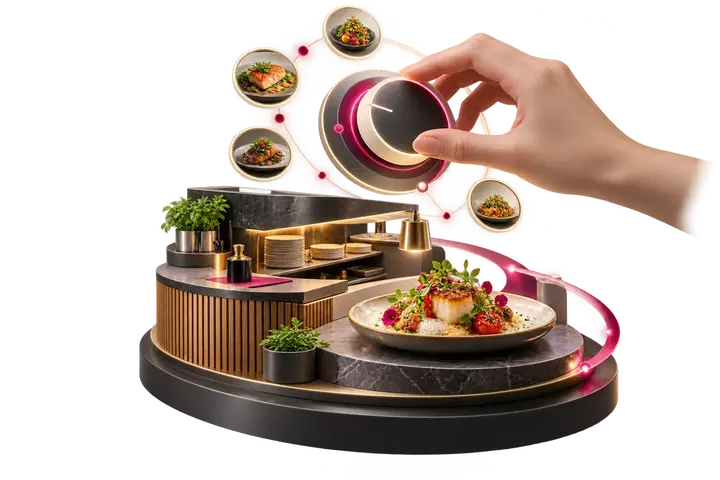
The most appealing future restaurant is not necessarily the one with the fewest people. It may be the one where people have more attention for the moments that deserve it. Automation can make repetitive work easier, but hospitality also includes interpreting an uncertain question, noticing discomfort and taking responsibility for a promise. The useful ambition is better service through well-chosen assistance, rather than treating complete autonomy as an achievement regardless of the guest's experience.
Give repetition to tools and meaning to people
Some work has a clear starting point and a recognisable result. Finding a known product, preparing a draft description or exploring a visual direction can fit that pattern. A capable tool helps the team begin closer to the useful decision. The benefit is less effort spent rebuilding the same context, not the disappearance of every human role around it.
Other moments depend on judgement. A guest may be unsure, disappointed or asking something the available information cannot settle. A restaurant builds trust by responding meaningfully, not by forcing every situation through the same answer. This distinction gives automation a more ambitious purpose: make room for skilled hospitality instead of making the staff defend an inflexible process that fails to understand why somebody needs help.
Imagine a service moment that matters
Consider a bistro with lentil soup and a garnish that can vary. A guest asks whether the current serving contains sesame. The valuable response begins with confirmed information and a responsible person. An assistant may help find what is known, but fluent language cannot fill a missing fact about the dish. The staff member can consult the kitchen and explain the actual offer.
The example is about the boundary of judgement, not medical guidance or a promise that a tool certifies food. The guest needs an answer grounded in the meal being served. A well-designed experience makes human involvement feel like competent service. It does not make the visitor feel awkward for asking a question that a generic response could not answer, and it does not treat confidence of wording as evidence.
Recognise what assistance already does
Nina GO AI's current restaurant assistant works with menu information and supported tasks. Menu changes follow a preview and approval path rather than being disconnected statements in a chat. That is a useful present-day example of assistance with an understandable result. The business can see the intended change, while the actual publication conditions still determine what becomes visible to guests.
Its AI report hints offer short observations and suggestions from an aggregate selected-period summary. They do not make purchases, set prices or forecast demand. This separation is a strength: managers receive material for thought without confusing a suggestion with an executed decision. The tool can help the team reach a better question, while the owner remains responsible for deciding which action fits the business.
Design future autonomy around a clear relationship
In the future we imagine, helpful automation makes its work understandable. People can see whether something is a suggestion, a draft or an action that the restaurant has chosen to carry out. A colleague can take over when the situation needs interpretation, without the guest having to repeat an entire story to justify speaking to somebody.
This is not a demand for a manual step in every routine. It is a case for matching freedom to the kind of work. Repetitive preparation can move quickly when the business has defined the task. A question about an uncertain product fact deserves a different response. The guest experiences a coherent service because the team knows what the tool contributes and where its own judgement adds value.
Make human attention the competitive idea
For a small restaurant, better assistance can mean more time explaining a dish, welcoming a regular or noticing that somebody is unsure. The future becomes attractive when technology supports the character of the place instead of asking the place to behave like a demonstration of technology.
Available tasks, provider readiness, permissions and the chosen package define the current arrangement. Current Nina GO AI plan information helps distinguish what can be shown today from what is being discussed as a future possibility.
Bring a repetitive menu task and a real guest question to a Nina GO AI demonstration. Ask how the tool helps the first and how the team remains able to handle the second. Meaningful automation earns trust by improving the work around people. Its strongest promise is not a restaurant without judgement, but a restaurant with more room to use it well.



