
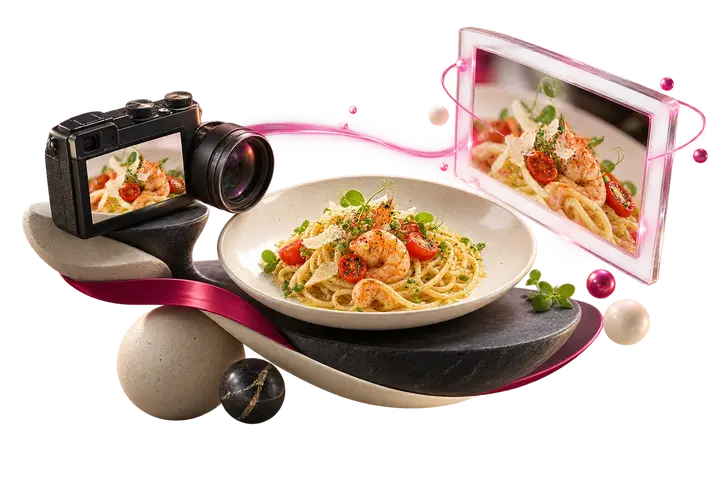
A dish can look wonderful in the kitchen and disappear in a crowded menu. Restaurants need images that give the food a clear place and express their character. AI expands the creative possibilities, but the strongest question is not whether a photograph or a generated image is universally better. It is what the image needs to communicate. A real product photograph and an illustrative visual can serve different jobs within the same restaurant brand.
Start with the promise to the guest
When a picture represents a particular dish, guests naturally use it to form expectations. The portion, accompaniments and presentation matter. A photograph of the actual plate offers a direct reference to what the kitchen serves. An AI illustration can help explore a mood or creative direction, but it does not become evidence that a finished meal looks exactly that way.
Nina GO AI connects product information with menu design and screen content. This gives imagery a useful context: the picture belongs to an offer, not merely an empty space. Decide whether it is showing the product, supporting a campaign idea or introducing the restaurant’s visual style before choosing how to make it.
Build one believable visual example
Imagine a hypothetical bistro introducing a pasta dish with cherry tomatoes and herbs. The team photographs its actual portion first. That image records the bowl, the amount and the visible ingredients. It can anchor the product presentation and help the team discuss what must remain recognisable when the visual treatment changes.
The same bistro might explore AI concepts for a surrounding campaign: a quieter composition, a particular colour mood or a different arrangement of the scene. Those experiments can develop the visual direction without adding ingredients or implying a larger serving. Real photography and creative exploration cooperate when each keeps its role, rather than competing to make the most spectacular-looking plate.
Describe a visual language, not just delicious food
A useful creative brief explains the intended feeling, viewpoint and use. A calm bistro may want restrained light and a familiar plate. A lively takeaway might choose stronger contrast and more energy. These are brand choices. Giving every image a different style can make a small restaurant look less coherent even when each individual picture is attractive.
Nina GO AI’s setup approach links templates, products, colours and arrangement. Its image tools can support generated alternatives and references when the relevant services are enabled. The benefit is room to explore a direction around a known product. A reference helps guide that work, while the restaurant still evaluates whether the resulting image represents the offer faithfully.
Think about the image after generation
A picture that works as a large feature may not work beside a small menu price. Consider the silhouette, crop and amount of surrounding detail. A transparent product cutout can give a design more flexibility, letting the same subject sit within a chosen layout without bringing an unwanted rectangular background along with it.
The dish name and explanation remain important when the image is small or unavailable. W3C guidance says informative images need text alternatives that convey their meaning. For a restaurant, that means keeping useful information in words as well as pictures. This is a design recommendation, not a claim that a particular image automatically makes a whole menu accessible.
Use creativity with one clear boundary
Generation depends on the available provider, credits, permissions and settings; it is not automatically free or included in every plan. Review the final result against the real dish before presenting it as a product image. If the image is intentionally conceptual, its use should make that role understandable rather than leaving guests to assume it is documentary photography.
Looking ahead, a coherent library of approved images could make future content work easier. That is a creative scenario, not a promise of automatic brand judgement. The useful foundation today is an agreed visual language and a clear relationship between product and image.
Compare the approaches with your own dish
Bring a real plate and a campaign idea to a Nina GO AI demonstration. Compare the actual photograph with an illustrative direction and see how each fits the intended menu or screen. Ask which details communicate the restaurant and which details distract from the meal.
The goal is neither to replace every photographer nor to avoid creative tools. It is to give each image a job it can perform honestly. With a reliable product reference and an intentional style, a restaurant can explore more visual possibilities while preserving the food promise that makes those pictures worth looking at.



