
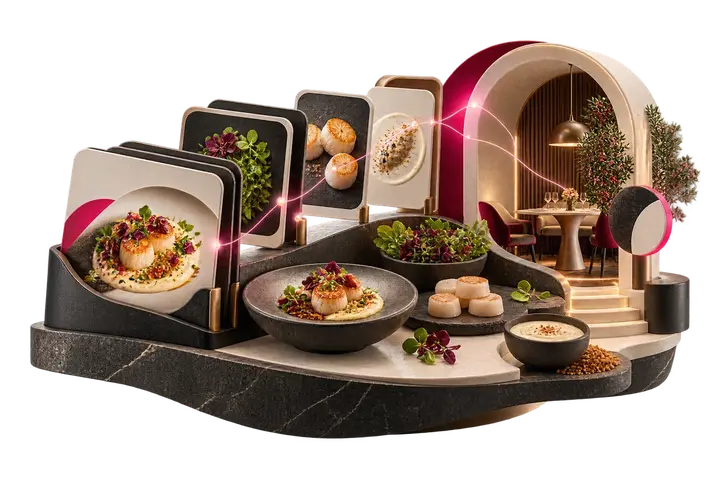
The next useful AI tool will still need to understand what a restaurant actually offers. A fashionable interface cannot supply the knowledge that only the business has: what belongs to a dish, how it is served and what the guest is being promised. That makes reliable product information more than an administrative task. It is an investment in the restaurant's ability to use new tools meaningfully, while keeping its own offer recognisable as technology changes.
Treat product meaning as a business asset
A good product name, clear description, honest image and understandable choice can support more than a single menu layout. Together they describe the offer in a form people can use. That knowledge already exists in the kitchen and in experienced staff. Giving it a stable expression makes it easier to present the same meal without rebuilding its meaning for every new piece of content.
The value is not the volume of text. A long description full of vague praise can be less useful than a short explanation of the actual portion and included accompaniment. Information becomes an asset when it helps somebody understand a real product. The restaurant's distinctive recipe and service promise remain its own contribution, even when a tool helps find better words or a more effective presentation.
Follow a signature dish
Imagine a bistro known for a mushroom tart with a seasonal side. The owner knows the portion, the standard recipe and which side is currently served. A reliable product description gives that knowledge a clear home in the working offer. The image supports the same serving, while an optional choice is explained as a choice rather than accidentally presented as part of every plate.
When the business wants a new lunch presentation, it can begin from that agreed meaning. The creative task becomes how to express the tart, not another round of guessing what it contains. Staff can also recognise whether a proposed description belongs to the current offer or an earlier idea. This is a small example of information gaining value through repeated, relevant use.
Give today's AI a stronger starting point
Nina GO AI already connects product and menu management with orders and screen content. Its assistant tools can work with menu context, and supported AI functions include product-text assistance, translation and visual generation under the configured conditions. A clear product definition gives these tools a better foundation for useful work. The business supplies the truth of the dish; the tool can help with its expression.
That relationship is more valuable than asking an assistant to invent the restaurant from a broad prompt. The owner can recognise what should remain stable and where there is room to experiment. A proposed image may explore a direction, but it does not document the actual plate. A fluent description still needs to preserve the agreed portion and ingredients.
Keep future possibilities separate from present promises
Future guests may encounter restaurant offers through different conversational or discovery experiences. Reliable names, descriptions and choices could be useful in those scenarios. This is a strategic possibility, not a claim that a complete global discovery marketplace already exists.
The durable benefit is being able to explain the offer clearly when a new context becomes relevant. Specific connections and future uses depend on what is actually available. Good information alone does not establish that every system can exchange every piece of business data. It does, however, give the restaurant something coherent to work with instead of making each future opportunity begin with an uncertain version of the menu.
Build value around the offer you want to keep
Nina GO AI's presented design journey begins with products and a template, then moves to shaping the result and using screens. A demonstration around the mushroom tart can show how the same product meaning supports different presentation decisions. This makes the information investment tangible: the owner sees where its culinary knowledge becomes a useful digital expression, rather than an extra document nobody recognises during service.
The selected plan, enabled functions, provider readiness and any paid generation define the current arrangement. Current package information helps match that arrangement to the intended work. Future flexibility should be discussed from that real starting point.
Bring a signature product and its true description to a Nina GO AI demonstration. Ask how the information can support the menu, suitable media and the assistant's understanding today. A future-ready restaurant is not one that claims to own tomorrow's technology. It is one that knows its offer well enough to give tomorrow's useful tools something valuable and believable to work with.



