
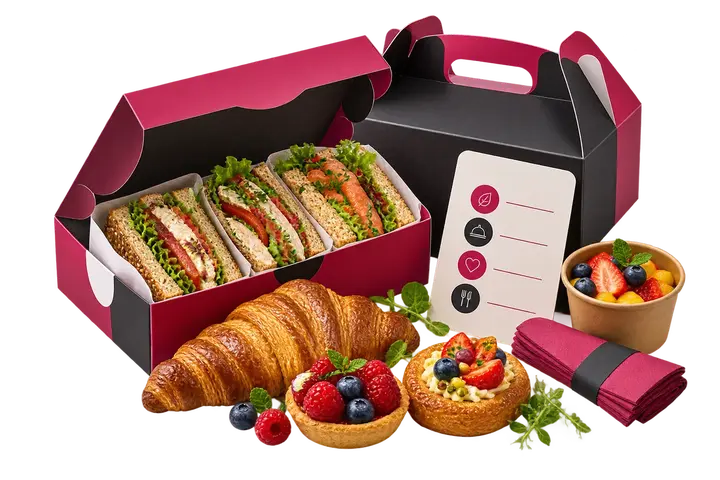
A request for an office breakfast can look like easy additional revenue. The difficulty appears when the same team must prepare the boxes, serve regular guests and answer questions about delivery. A small café does not need to become a full catering company to handle group orders well. It needs a clearly defined offer and a realistic decision about what it can fulfil alongside normal service. The useful first question is capacity, rather than how large the order sounds.
Offer what fits the existing kitchen
Choose products the team already prepares reliably. Consider whether they hold their intended quality during the agreed journey and whether they can be packed without complex last-minute assembly. A menu that works at a table may not suit a shared office breakfast. The presentation should describe the actual packed offer, including portion expectations, drinks and any separate components.
Food safety remains part of the operating plan. The WHO's guidance provides general principles, while the establishment must follow its own applicable handling procedures. Packaging convenience does not justify improvising storage or transport conditions. If the café cannot safely deliver a proposed item, change the offer or decline that part of the request.
Find the bottleneck before accepting
In a café, preparing sandwich fillings is straightforward but the small counter is also needed for morning coffee service. The bottleneck is the packing space, not the number of sandwiches on the order. An alternative collection time or a narrower choice may resolve the conflict. Increasing the quantity without noticing that constraint would make both services less reliable.
Write down which person prepares, checks, packs and hands over the order. Include the equipment, workspace and supplies they need. If that allocation removes an essential person from the ordinary service, decide how the gap will be covered. A staff member cannot simultaneously supervise a busy espresso station and verify a complicated group delivery merely because both tasks appear on the same schedule.
Confirm the agreement in one place
The customer and the café should share a clear record of the products, portions, agreed substitutions, collection or delivery arrangement and responsible contact. Set an understandable deadline for changes based on actual preparation needs. Any deposit or cancellation arrangement should be explicitly agreed through the business's normal process; it should not be presented as an automatic software feature.
Avoid gathering choices through scattered messages from every attendee. Ask the organiser to confirm a consolidated list, then repeat any unresolved detail before committing. A missing answer about an included drink should not become a guess at packing time. When the list changes, identify the current approved version and remove obsolete working copies from the preparation area.
Cost the work as well as the food
Count packing materials, preparation and checking time, transport arrangements and any disruption to regular trade. The purchase cost of ingredients alone does not show whether the order makes business sense. Official price indices describe wider movements; the café still needs its current invoices and actual production method for the specific offer.
Do not add a large unexplained buffer to every item and call it planning. Identify where uncertainty sits. A variable number of attendees, a long journey and a complicated substitution request are different problems. Each needs a clear condition or a suitable adjustment, rather than one vague premium that leaves the operational issue untouched.
Keep a final confirmation step when the organiser changes the request. Check that the revised offer still fits the available people and space. An earlier acceptance does not mean every later addition is feasible. Explain a limit while there is time to choose an alternative, instead of allowing the packing team to discover the conflict at the handover.
Review leftovers and the handover
UNEP's food-waste work emphasises the value of measurement. For a group order, a useful small record is what was prepared, what was handed over and what remained at the café. This does not mean that every event should produce no surplus. The information helps the next quotation reflect experience.
At handover, check the package list with the organiser and explain any components that need separate handling. Afterwards, ask whether the contents were understandable and the agreed timing worked. Use the answer to refine the offer rather than immediately expanding the menu. A dependable, limited group-order service can be more valuable to a small café than accepting every request and repeatedly disrupting its everyday guests.



