
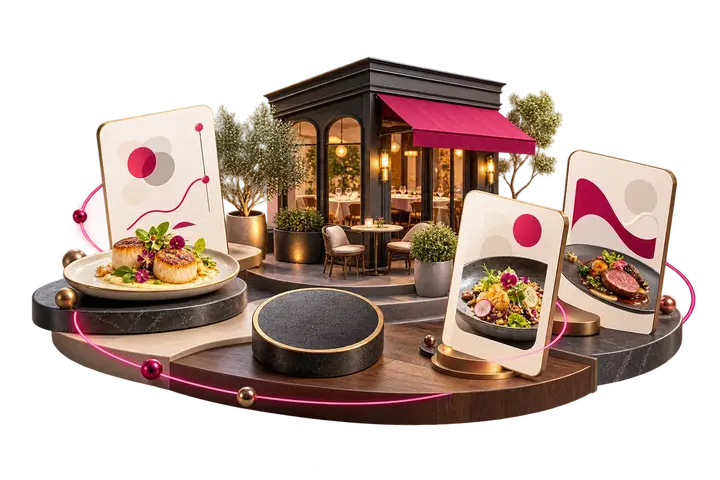
An agency may create a restaurant’s logo, website and promotional material, then leave the daily software experience to another brand. White-label software opens a different relationship: the agency can bring its identity and service into the tools the restaurant actually uses. The opportunity is not simply another referral link. It is a more coherent offering around menu, presentation and everyday work, with a recognisable agency responsible for helping the client use it well.
Make the software part of your visible offer
Nina GO AI’s white-label model puts the agency’s identity in the management interface, customer-facing screens and access address. The public offering includes the agency’s own logo, colours and domain, with no Nina GO AI branding on the customer-facing screens described in that model. This gives an agency a software proposition it can present under its own name.
The important benefit is continuity. The restaurant does not meet one identity during the design project and an unrelated identity in daily use. Branding alone does not create a valuable service, however. It gives the agency a clear place to connect its advice, implementation and client relationship with the software experience that follows.
Picture a realistic agency project
Imagine a hypothetical agency working with a neighbourhood bistro. The bistro has warm colours, a distinctive logo and a familiar menu. The agency wants the software presentation to belong to that character rather than looking like a disconnected addition. It brings the brand identity together with the menu work and the way the client will access its workspace.
Its value lies in the relationship between the parts. The designer can explain a chosen layout, the onboarding contact knows the product information and the restaurant knows where to ask for help. The agency’s name becomes associated with a useful ongoing service, not just a file delivery at the end of a project.
Sell the work that makes software useful
A restaurant still needs its products explained, its visual choices made and its team introduced to the workflow. An agency can build services around those needs: menu preparation, visual adaptation, launch support and agreed ongoing help. These activities apply the agency’s skills where the client has practical questions, instead of promising that a new logo makes every task automatic.
Nina GO AI connects menu design, ordering and screen content in one platform. That breadth gives the agency a coherent context for its service. The offer should still follow the client’s actual needs. A small bistro may need a focused starting point, while another operation may have a wider presentation project. More features are not automatically a better service package.
Build commercial clarity around the promise
The agency should understand the current software scope and its own delivery work before defining the client offer. Relevant plan details and conditions belong in that assessment. Setup, agreed content work, support and later changes need a shared meaning. Clear boundaries help the restaurant know what it receives and help the agency organise the work it has committed to provide.
White label does not make the service passive or guarantee a margin. Someone still prepares information, answers questions and maintains the relationship. An agency that recognises that effort can price and describe its own services more thoughtfully. The persuasive promise is dependable expertise under a familiar brand, not effortless income detached from actual client work.
Explore the AI service opportunity realistically
AI creates an interesting direction for agency work: helping clients develop clearer product language, explore visual concepts and discuss aggregate report observations where the relevant functions are enabled. The agency can turn tool access into useful interpretation and creative support. That is a service opportunity based on skills, rather than a claim that AI automatically runs every restaurant campaign or decision.
A future with more connected agency services is a scenario, not a guaranteed return. Today’s foundation is the white-label offer alongside the supported restaurant tools. Availability depends on configuration, plan and any required provider or credit readiness. Keep the distinction brief and clear so the client can understand what is useful now and what remains an idea.
Bring your agency identity to the demonstration
For a Nina GO AI discussion, bring your agency identity and a representative restaurant menu. Explore how the visible brand, access address and client workflow would fit together. Ask who the client contacts for help and how your own design and onboarding services will connect with that experience. This makes the proposal concrete before it becomes a sales promise.
The strongest white-label proposition is not hiding the origin of a piece of software. It is taking responsibility for a coherent branded service. For an agency that understands hospitality, Nina GO AI can provide a foundation on which its own knowledge, design and ongoing support become a recognisable part of the restaurant’s working day.



