
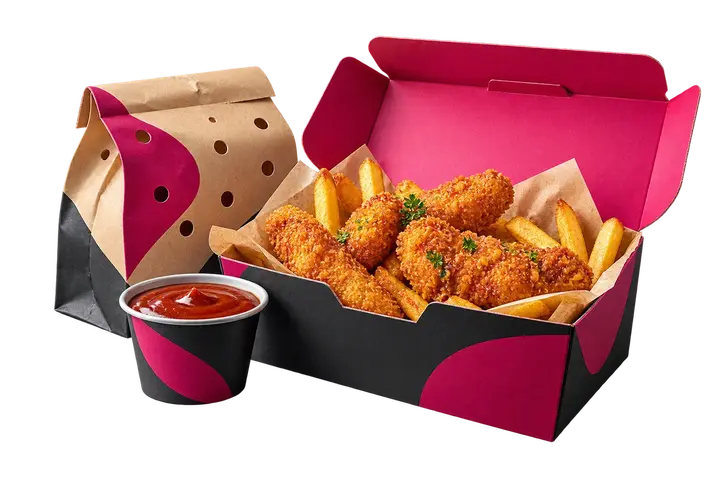
A dish can leave the kitchen crisp and reach the customer soft without the recipe being the only problem. Once the lid closes, the food travels in a different environment. Steam, sauce, stacking and waiting all affect the result. A handsome open box on the counter therefore tells only part of the story. The useful question is how an actual order is prepared, closed, carried and opened at its destination. Treating the packaging as part of that whole journey provides a better starting point than searching for a single ideal container.
Think about the food inside the box
A crisp coating and a juicy side dish have different needs. Moisture may collect against closed surfaces, while sauce or garnish can change the coating through direct contact. Do not jump immediately to a thicker or more expensive box. First identify which component affects another. Depending on the dish, a divider, a separate sauce or a revised takeaway presentation may be more useful than replacing the container alone.
Imagine a bistro sending crisp chicken with salad. Placing the salad under the hot item can compromise the qualities expected of both. When testing a separated arrangement, also observe whether the guest can assemble and eat the meal easily. Packaging should support the dish without making customers recreate a small kitchen at home or search through an unreasonable number of individual components before they can begin eating.
Choose materials for their intended use
The words paper, plastic or another material name do not settle every suitability question. A supplier should explain which foods and conditions a product is intended for. The European Commission's food-contact materials framework addresses this issue of appropriate use. It does not give every container a universal approval for every country or application. Check the actual product against the business's own use and requirements.
Test closure, leakage and stacking with a real portion. An empty box may feel strong but behave differently when filled. Pressure in the transport bag, tilted handling and contact between lids matter too. Colour and attractive product photographs cannot replace these checks. Staff should understand the supplier's use instructions as well, so that the same packaging is not handled in completely different ways from one shift to another.
Reproduce the normal service journey
Put a trial order through the usual preparation process. Record when the food is cooked, when the lid closes and where the order waits. Keep recipe and portion consistent when comparing packaging arrangements. Changing the sauce and the container at the same time makes it difficult to identify which choice affected the outcome. A small number of comparable trials is more useful than a collection of impressions with no common baseline.
Food safety is not a negotiable variable in this exercise. The business's verified time, temperature and hygiene procedures still apply; the WHO's basic approach also starts with safe preparation. Do not disrupt safe transport simply to improve crispness. Where a particular food needs measurement or specialist assessment, an appealing appearance or a brief tasting cannot substitute for the necessary checks and controls.
Agree a consistent packing sequence
When staff arrange the same order differently, customers receive different results. Decide where the sauce goes, how hot and cold items are separated and who performs the final lid check. A short visual example at the packing station can help. The goal is not a lengthy procedure book but a process that remains understandable under pressure and repeatable after a change of staff.
The menu should also describe what is actually supplied. If a photographed sauce arrives separately, make it easy for the customer to find. Otherwise a complete order may still feel incomplete. The person opening the container does not know the restaurant's internal logic. Clear names and an intelligible arrangement often help more than adding extra pieces whose purpose is not obvious from the customer's side.
Look beyond the price of the container
A packaging review should include material cost, packing time, leaks, missing items and reasons for returns. The cheapest box can become costly when an order is lost; the most expensive can still be unsuitable. The European food-waste framework offers useful background for considering deliveries that go uneaten. It does not mean that every additional layer of packaging automatically prevents waste or improves the economics of a meal.
Avoid deciding from a single successful trial. Observe different employees and ordinary transport conditions. Classify complaints more precisely than “food was disappointing”: leakage, texture, mixed sauce and unclear information suggest different causes. This reveals what needs changing: the recipe, the container, the packing sequence or the promise made to the customer. A vague quality complaint can then become a specific operational improvement that the team is able to repeat.



